.png)
Sailing Adventure
Age: 2 years old
Class Size: 15 children
No. of Lesson: 4 classes in the whole course
Lesson Duration: 1 hour
Preparation
1. Gather a large book or a digital story "We Go on a Ferry" for group reading.
2. Prepare visual aids of ships, boats, ferries, docks, and the sea.
3. Set up props or toys that resemble ships and ferries for interactive play.
Part 1: Story Introduction and Vocabulary
Target Vocabulary:
- ship
- boat
- ferry
- dock
- sea
Target Instruction:
- "Where is the _____?"
- "The _________ sails in the sea."
Learning Objectives:
By the end of the lesson, students should be able to:
1. Recognize and name different types of water transport mentioned in the story.
2. Use the target sentences to describe the location and action of the ferry.
3. Engage with the story through interactive reading and related activities.
Materials List:
- Book or digital story "We Go on a Ferry"
- Visual aids depicting ships, boats, ferries, docks, and the sea
- Ship and ferry toys for hands-on activity
- Flashcards with the target vocabulary
### Class Details:
1. Warm-Up (5 mins):
- Begin with a simple hello song incorporating gestures for waves and boats.
- Show flashcards of the ship, boat, ferry, dock, and sea, and introduce each word clearly and
slowly.
2. Story Introduction (5 mins):
- Introduce the book "We Go on a Ferry".
- Show the cover and ask predictive questions like "What do you think this story is about?" and "What can we see in the picture?"
3. Interactive Reading (10 mins):
- Read the story aloud, pausing after mentioning each key vocabulary word to show its picture and encourage children to say the word.
- Use the target sentences interactively. Point to a picture of a ferry and ask, "Where is the ferry?" and help them answer, "The ferry sails in the sea."
4.Vocabulary Reinforcement Game (5 mins):
- Use the ship and ferry toys to set up a small scenario on a 'dock' made from blocks.
- Encourage the children to place the ferry or ship at the dock and then move it through the 'sea', using the target sentences.
Assessment:
- Observe if the children can identify and name the different types of water transport.
- Assess their ability to use the target sentences in context.
- Evaluate their engagement and interaction with the story and props.
Remarks:
- Ensure that each child has a chance to interact with the props and participate in the story.
- Repeat new vocabulary multiple times and encourage children to speak up by gently
prompting them.
- Keep the activities dynamic and responsive to the children's interest and energy levels.
Part 2: Art and Craft Activity
Making a Ship
Learning Objectives:
By the end of this activity, students should be able to:
1. Use art materials to create a ship using a paper plate and construction paper.
2. Develop fine motor skills by cutting, folding, and gluing different materials.
3. Reinforce vocabulary and sentence structures learned in Part 1 through creative expression.
Materials List:
- Paper plates
- Blue and white paint
- Construction paper (various colors)
- Scissors (for teacher use or with close supervision)
- Glue
- Markers or crayons
- Additional decorative materials (e.g., stickers, cotton balls)
Class Details:
1. Introduction (5 mins):
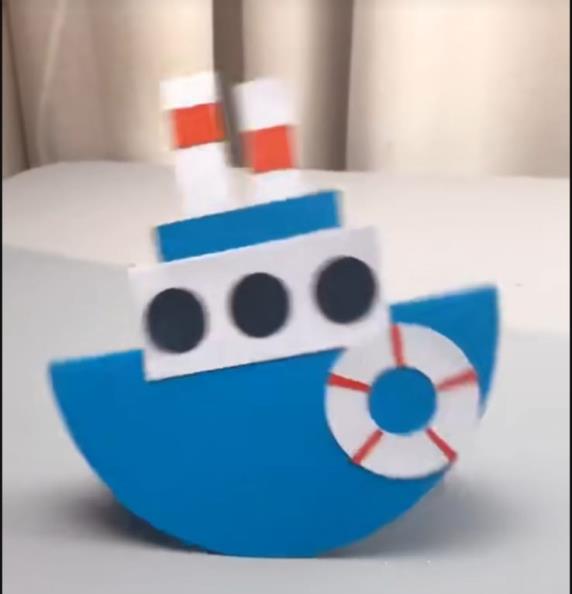
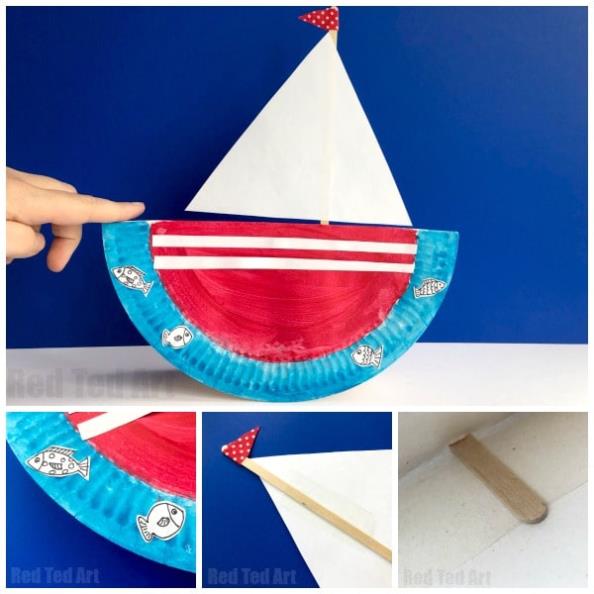
- Introduce the art activity by showing a sample ship made from a paper plate and
construction paper.
- Discuss each part of the ship as it relates to the vocabulary learned: ship, boat, ferry, dock,
and sea.
2. Making the Ship (20 mins):
- Distribute one paper plate per child. Assist them in painting the plate blue for the sea and white for the ship’s body. Allow to dry slightly.
- Help children fold the paper plate in half to form the ship's body.
- Cut construction paper into shapes for the upper deck, chimneys, portholes, and floating tube. Children can choose colors and help with placing where to cut.
- Guide the children in gluing the cut pieces onto the folded paper plate to complete the ship.
- Encourage creativity by allowing them to add details like windows, flags, or lifebuoys using markers, crayons, or stickers.
3. Interactive Play (5 mins):
- Once the ships are assembled, place them on the table and show the children how to gently rock them left and right, simulating the motion of a ship at sea.
- Use this opportunity to reinforce the target sentence: "The ship sails in the sea."
4. Clean-Up (5 mins):
- Assist children with cleaning up their spaces, organizing materials, and washing hands.
Assessment:
- Observe if the children can identify and use the vocabulary words in context while making
their ships.
- Assess their ability to follow instructions during the craft activity.
- Evaluate their engagement and participation in the art activity and their ability to use fine
motor skills.
Notes for Teachers:
- Ensure that all children are involved in each step of the craft, providing help where necessary.
- Use this opportunity to reinforce the vocabulary and sentences by describing actions and parts of the ship during the activity.
- Provide plenty of positive feedback to encourage participation and creativity.
Follow-Up:
- Display the children’s ships in the classroom, possibly creating a 'Tiny Tales Sea' on a bulletin board where all ships can be shown sailing.
- Encourage parents to discuss any trips or experiences related to boats or ships with their children at home, enhancing their real-world connection to the vocabulary.
Image References for Art and Craft product: