.png)
5.3 Shapes and Counts in the Garden
Age: 2 years old
Class Size: 15 children
No. of Lesson: 4 classes in the whole course
Lesson Duration: 1 hour
Preparation
1. Gather flashcards or objects representing various shapes and sizes like circles (apples) and ovals (pumpkins).
2. Prepare props or pictures showing numbers 1 to 10.
3. Select the book "Apples and Pumpkins" by Anne Rockwell, avoiding the last part about Halloween.
Part 1: Story Introduction and Vocabulary
Target Vocabulary:
- big, small, round, long
- numbers 1 to 10
Target Instruction:
- "How many _______ are there?"
- "[Fruit] are small."
Learning Objectives:
By the end of the lesson, students should be able to:
1. Recognize and name shapes and compare sizes (big, small).
2. Count objects from 1 to 10.
3. Understand and use the target sentences in context.
Materials List:
- Book: "Apples and Pumpkins" by Anne Rockwell
- Flashcards depicting shapes and numbers 1-10
- Real fruits like apples and pumpkins (optional) or their realistic pictures
### Class Details:
1. Warm-Up (5 mins):
- Start with a simple greeting and a shape song that mentions circles, ovals, and other shapes to prepare the children for the lesson's theme.
2. Story Introduction (5 mins):
- Introduce the book "Apples and Pumpkins" and show the cover. Ask the children to point out any shapes they recognize (e.g., round apples, long stems).
- Briefly explain that the story is about visiting a farm to pick apples and pumpkins, focusing on the shapes and sizes of these fruits.
3. Shape Recognition and Counting Activity (10 mins):
- Use flashcards or real fruits to demonstrate different sizes and shapes. For example, show a large pumpkin and a small apple.
- Encourage the children to use the target sentences, e.g., "How many apples are there?" and "Apples are small."
- Lead a counting game using the fruits, where children count from 1 to 10, enhancing their number recognition and counting skills.
4. Interactive Readiing (10 mins):
- Begin reading "Apples and Pumpkins", pausing to point out different fruits and ask about their shapes, sizes, and numbers. Use the flashcards to reinforce the vocabulary and concepts.
- Skip the last part about Halloween, focusing on the educational content relevant to shapes, sizes, and numbers.
Assessment:
- Observe if the children can correctly identify shapes and sizes.
- Assess their ability to count accurately from 1 to 10.
- Evaluate their use of target vocabulary and sentences during the activities.
Remarks:
- Keep the language simple and clear.
- Allow each child to participate actively by pointing out shapes or counting objects.
- Use props and visuals extensively to aid understanding and retention.
- To meet the learning objectives and ensure developmentally appropriate content, the last part of the story, which is about Halloween, can be skipped.
Part 2: Art and Craft Activity
An Apple Tree
Learning Objectives:
By the end of this activity, students should be able to:
1. Identify and utilize different art materials to construct a representation of an apple tree.
2. Continue to develop fine motor skills through cutting, pasting, and molding.
3. Use counting skills in a practical and artistic context.
Materials List:
- Green construction paper for grass
- Scissors (for teacher use or with close supervision)
- Glue
- Pre-cut toilet paper rolls for the tree trunk
- Green tissue paper for leaves
- Red clay for apples
- Reference picture of the apple tree art project
Class Details:
1. Introduction (5 mins): |
- Introduce the art project by showing a reference picture of the apple tree. Explain the different parts they will create: grass, trunk, leaves, and apples.
- Discuss the materials they will use for each part of the tree.
2. Creating the Apple Tree (20 mins):
- **Grass**: Guide children to cut strips of green construction paper into grass. Supervise closely if scissors are used by children.
- **Trunk**: Hand out pre-cut toilet paper rolls and assist children in gluing them onto their paper as the tree trunk.
- **Leaves**: Show children how to crumple green tissue paper to make leaves and glue them around the top of the trunk.
- **Apples**: Guide children to roll small amounts of red clay into balls and stick them onto the tree as apples.
3. Counting in Art (10 mins):
- Incorporate counting by asking children to count how many pieces of tissue they used for leaves or how many apples they made. Use the target sentence, "How many _______ are there?" to reinforce language skills.
4. Clean-Up (5 mins):
- Assist children with cleaning up their spaces. Collect unused materials, and help children wash their hands.
Assessment:
- Observe if children can follow instructions to use different art materials.
- Evaluate their ability to count objects during the art activity.
- Monitor their fine motor skills during cutting, pasting, and molding activities.
Notes for Teachers:
- Provide clear, step-by-step instructions and demonstrate each step before letting the
children do it.
- Encourage creativity while guiding them to achieve the task.
- Ensure safety, especially when using scissors or other sharp tools.
- Praise each child’s effort to foster a positive learning environment.
Follow-Up:
- Display the completed apple trees in the classroom.
- Encourage parents to engage in simple art projects at home, using household items to
reinforce the concepts learned.
Image References for Art and Craft product:
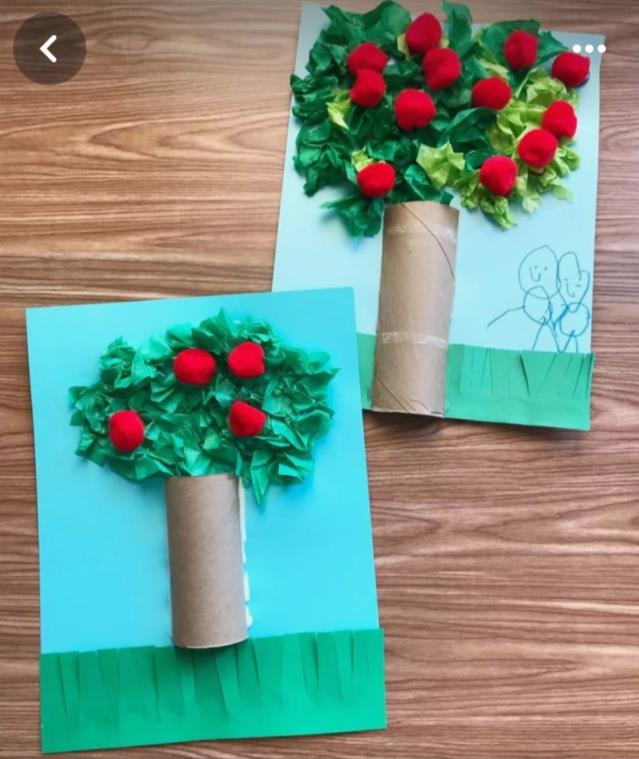
The reference picture displays two artworks. The artwork on the left is designed to be facilitated by an early years teacher without an art background. This teacher will provide clear instructions and guide the creation of the art piece. In contrast, the artwork on the right is intended for execution by a teacher with an art background. This approach involves using various shades of green tissue paper to depict a lush, mature tree. Additionally, this artwork maximizes the use of the entire paper to enrich the visual content. It also incorporates children's personal touches, such as drawings of figures, which are tailored to their fine motor skills development. For this purpose, suitable mark-making tools are provided to accommodate their abilities.